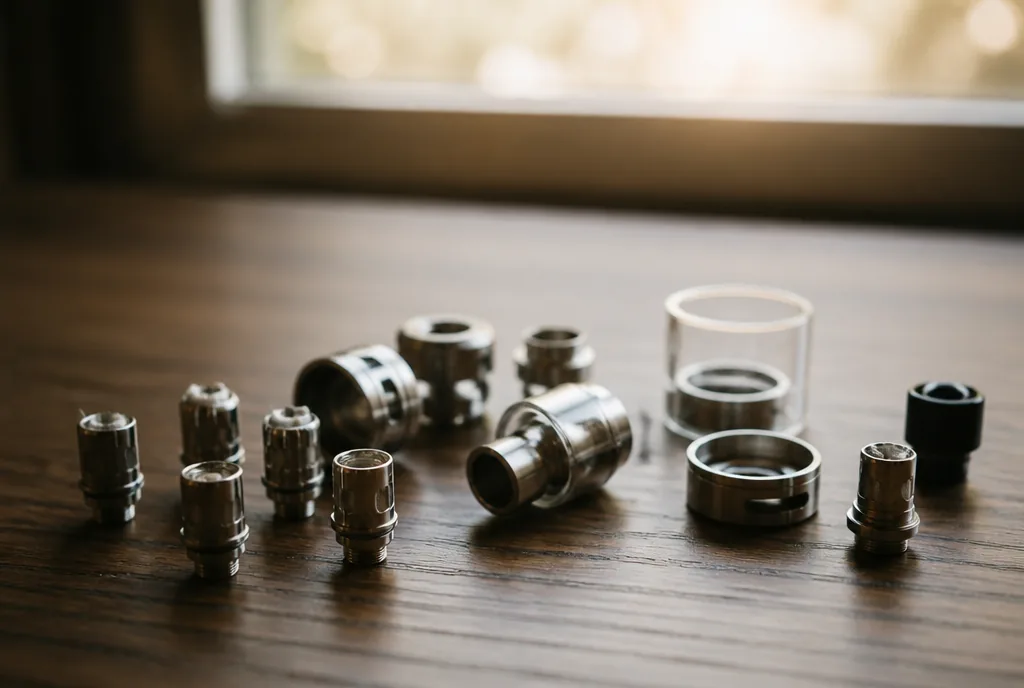
Centaurus BT200: runtime on two 18650 cells
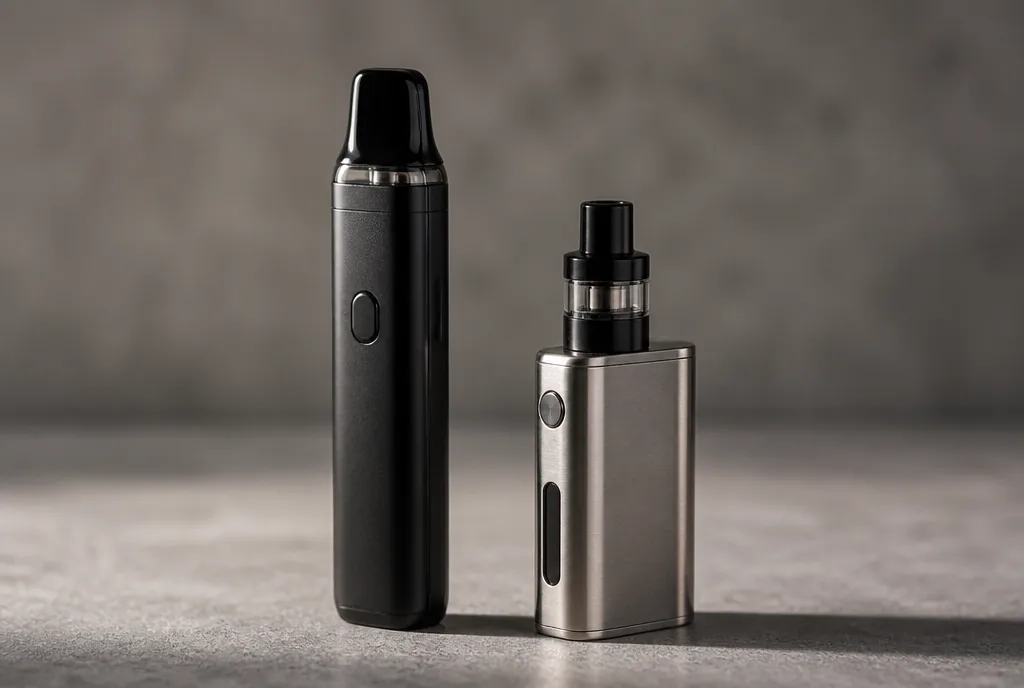
Two hundred watts printed on a 2.4 inch colour screen, two battery bays, and not a single milliamp hour figure anywhere on the listing. The Lost Vape flagship is a textbook illustration of the reading problem posed by removable cell devices: runtime appears nowhere, because it depends entirely on what you put inside. Here is how to reconstruct it from the figures British retailers do publish.
What the Centaurus BT200 listing gives, and what it omits
UK stockists agree on the skeleton. The Centaurus BT200 runs on two external 18650 cells, not supplied, tops out at 200 W, charges over USB C at 5 V and 2 A, and is built around the Quest X 3.0 chipset with Bluetooth 5.1 connectivity.
What is missing is precisely what would decide runtime: no capacity, no minimum discharge specification, no stated duration of use. Ecigone, Vaping101 and Legion of Vapers are all silent on those three points, and none of them is being evasive. The information genuinely does not exist at the factory.
So the figure has to be rebuilt in two steps. First convert the cells you choose into stored energy, then set that energy against the power you actually vape at. Both steps are divisions, and neither requires anything beyond the numbers already on the page.
Turning two 18650 cells into stored energy
The calculation means fixing a capacity, since the device imposes none. UK listings for 18650 cells cluster between 2500 and 3500 mAh, which gives the realistic bracket around this device.
Take the upper end. Stored energy works out as 3.5 Ah multiplied by 3.7 V, which gives 12.95 Wh per cell, or 25.9 Wh for the pair. That is the number that matters, and it is nowhere on the box.
With two 2500 mAh cells the total falls to 18.5 Wh. The gap between the two configurations exceeds 40 percent on a device that is otherwise strictly identical, which is the single most useful thing this article has to say.
Estimating a runtime for the Centaurus BT200
No duration figure appears on any listing, and presenting one as measured would be dishonest. What follows is an arithmetic projection with every assumption shown.
A puff draws a given power for a given time. At 100 W over two seconds it uses about 0.056 Wh. At 50 W over the same two seconds it uses about 0.028 Wh. The ratio is exactly one to two, before anything else is considered.
Start from 25.9 Wh stored, hold a conversion efficiency near 90 percent, and assume a discharge carried down to the point where the board cuts off. Usable energy comes out around 23.3 Wh, which places the result near 415 two second puffs at 100 W, and roughly 830 at 50 W.
Those are orders of magnitude for comparing two settings, not durations anyone has recorded. Three things pull them down in real life: voltage sags under high current, the cut off arrives before the cell is empty, and the colour screen with its Bluetooth link draws power between puffs.
The 200 watt figure and how to read it against your own cells
The most visible number on the listing is also the one that constrains which cells belong in the device. On a series arrangement the same current passes through both cells, so it is that current, not the wattage, that has to be compared against the specification of the cells you own.
The method is worth learning once rather than looking up each time. Two cells in series give a nominal pack voltage of 7.4 V. Divide the wattage you actually use by that voltage and you get an approximate current draw in amps, before conversion losses are counted at all.
Then open the datasheet published by the maker of your specific cells, find the continuous discharge line, and compare the two figures yourself. That comparison is the whole exercise, and its answer belongs to your cells rather than to a general rule or a number quoted in a forum thread.
The practical consequence is simply that the maximum power on the box is not reachable with any arbitrary pair. Which is why the trade off between capacity and current, set out in our guide to reading a 21700 battery, matters just as much on the 18650 format.
Internal charging: what 5 V and 2 A give across two bays
The USB C port accepts 2 A. That current does not go to one cell: it is split between the two occupied bays, following the same rule that governs any multi bay charging arrangement.
Each cell therefore receives something close to 1 A. On 3500 mAh cells that puts theoretical charge time somewhere around three and a half hours, with the closing constant voltage phase excluded from the count.
An external unit set to a higher current per bay would cut that figure substantially. The full reasoning on charge regimes, and why the amp figure on a box is only half the story, sits in our piece on choosing a vape battery charger.
Cell handling on a dual bay device
Two cells in series must be matched: same brand, same model, same age, charged together and used together. An imbalance makes the weaker cell work beyond its share, wears it faster, and tends to trip the device protections at unhelpful moments.
The wrap is a working insulator rather than a label. A cell whose sleeve is split, torn or lifting at the shoulder gets re wrapped or retired before it goes back into a bay, because the metal underneath is live along the whole body.
Cells removed from the device travel in a rigid case, never loose in a pocket or a bag alongside keys and coins. And charging happens on a unit designed for the size and chemistry involved, following the cell manufacturer instructions rather than a habit picked up elsewhere.
Where British listings disagree, and why it matters
One last point deserves attention from anyone comparing figures: retailers do not publish the same ones. On this device the mode count varies from five to seven depending on the source consulted, and the tank dimensions differ by several millimetres between listings.
None of that invalidates anything, but it is a reminder that a value found on a product page remains a value from a product page. The habit worth building is checking the same figure across two independent sellers before treating it as settled.
There is one figure British buyers can rely on completely. Refillable tanks sold in the United Kingdom are capped at 2 ml, and nicotine containing e liquid at 20 mg/ml in 10 ml bottles, so the tank capacity quoted on an overseas listing for this same kit does not describe what arrives at a UK address.
That cap also explains why a device of this output sits at the specialist end of the British market rather than the mainstream. A dual cell layout of this kind belongs to the same family covered in our look at the 21700 mod segment, where the reasoning transfers directly to the larger format.
Frequently asked questions
Can a single cell be used in a dual bay device?
No. A series arrangement needs both bays occupied to establish the voltage the board expects, and the device will simply refuse to fire otherwise.
Do the two cells have to be strictly identical?
Same model, same capacity and same state of wear are the rule on this kind of layout. An imbalance makes the weaker cell carry more than its share of the work.
Does the highest power mode change runtime?
It sets output to the maximum the detected coil allows. Mechanically, more watts per puff means fewer puffs from the same stored energy, in direct proportion.
Does the Bluetooth link draw a measurable amount?
No consumption figure is published by the brand or by the reviewers consulted. The only verifiable observation is that the function is present and active between puffs.
Why does capacity appear on no listing at all?
Because the cells are not supplied. The manufacturer cannot state a capacity it does not ship, and retailers reproduce that absence exactly as they receive it.
Reading the Centaurus BT200: three values to rebuild yourself
The Centaurus BT200 publishes its power, its modes and its connectivity, then leaves the buyer to reconstruct the important part: the stored energy, which depends on the cells chosen, the current drawn at high output, and the charge time once the port current is split across two bays.
Those three calculations take a few divisions and say considerably more about daily use than the number printed in large type on the box. They also transfer to every other removable cell device on a British shelf, which makes them worth doing once properly rather than looking up repeatedly.
Editorial content for adult readers only. Vaping products generally contain nicotine, a substance that causes addiction. Not for sale to anyone under 18 in the United Kingdom. This article is not a buying recommendation.
Further reading
The market
21700 mod: why the format took over box mods
Why UK makers moved from 18650 to 21700, what the larger cell changes in runtime and bulk, and how single and dual battery mods split the market.
Trends
Oxva VPrime: what 2600 mAh actually covers
Oxva VPrime: 2600 mAh, 60 W, USB C charging. The calculation that links those figures to a runtime, and what the pod chosen changes in the result.
Data
Coolfire Z80: 80 watts from a single 18650
Coolfire Z80: 80 W advertised, one 18650 cell, USB C charging. What arithmetic says about the power actually sustainable and about runtime.