Vape battery charger: reading amps and time
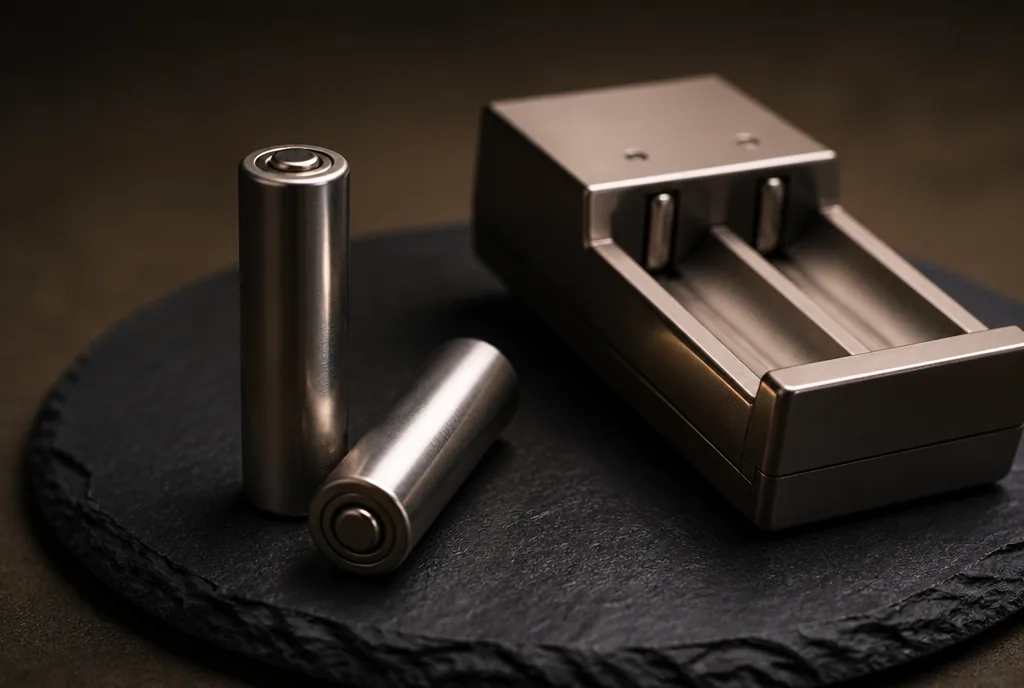
On a charger listing, one number decides almost everything: the charge current, in amps. It sets how long a recharge takes, it governs how hard the cell is worked, and it changes value the moment you drop in a second cell instead of one. British catalogues still bury it behind the bay count and the size of the screen. Here it goes back in the middle, with the arithmetic attached.
What the charge current tells you about a vape battery charger
Charge current is expressed in amps and reads as a rate. A vape battery charger advertised at 2 A fills twice as fast as one at 1 A, at identical cell capacity, and that is the whole of the headline claim.
The basic calculation is a division: capacity in milliamp hours divided by current in milliamps. A 5000 mAh cell charged at 2000 mA therefore needs about two and a half hours in theory, against ten hours at 500 mA.
That result is a floor, not an observed duration. Charging ends with a constant voltage phase that is deliberately slower, and it stretches the tail of the cycle. The figure is there to compare two devices, not to plan an evening around.
The 4.2 volt ceiling that bounds every calculation
All of these figures refer back to the same voltage limit. British listings are consistent on the point: a vaping cell is charged up to 4.2 V, and that ceiling belongs to the cell chemistry rather than to any particular charger.
Below it, the nominal 3.7 V serves as the reference for energy calculations. At it, the electronics in the charger cut off. That cut off, rather than any notion of being full, is what defines the end of a charge.
Understanding the ceiling prevents a common misreading. One device does not charge more than another, it charges faster or slower up to the same threshold, and every claim of a bigger charge is really a claim about speed.
Bay count: what it changes in the arithmetic
The number of bays is the criterion catalogues push hardest, and on its own it says nothing. What matters is how the unit splits its total current between the cells actually present.
Some units share a fixed total. Nitecore publishes exactly this behaviour on several of its multi bay models: a given current on one occupied bay, roughly half that figure per bay when two are in use. The available current is divided, not duplicated.
The consequence for the arithmetic is direct. Charging two cells at once does not halve the wait, it roughly doubles it against a single cell in the same unit, which is the opposite of what most buyers assume.
Other units let you choose. Efest, Xtar and Vapcell all sell models with selectable charge regimes across several bays, and this setting is the real lever on the whole exercise. Moving a given cell from the lowest setting to the highest can cut the theoretical time by a factor of four, and works the cell correspondingly harder in exchange.
Reading the current against the capacity, not on its own
An amp figure is never judged in isolation. It is judged against the capacity of the cell being charged, because the same current is a gentle regime on a large cell and an aggressive one on a small cell.
The method is a single division. Take the charge current in amps, divide it by the capacity expressed in amp hours, and you get a ratio. The same 2 A represents 0.4 times the hourly capacity of a 5000 mAh cell, and 0.8 times that of a 2500 mAh cell.
That ratio, and never the raw amp figure, is what tells you whether a setting is comfortable for the cell in front of you. Then the last step is to open the datasheet for that exact cell and read the maximum charge current its own manufacturer publishes, because that document, not a shop listing and not a habit, is the authority.
Two listings to read together: the cell and the charger
A vape battery charger is chosen from the cell, never the other way round. Two figures on the cell listing are enough to settle it: capacity, which gives duration, and published cycle life, which gives service life.
Vaping cells are commonly quoted at a few hundred cycles, and every full charge consumes one unit of that counter whatever device performed it. The counter does not care whether the charge was fast or slow, only how much charge passed.
That number turns usage into a calendar. At one charge a day, four hundred cycles is a little over thirteen months with no break at all. At two charges a day the same cell lasts half as long, and the running cost doubles accordingly. The capacity figures that feed this calculation are covered in our guide to reading a 21700 battery.
External charging or charging through the device
The question does not resolve on principle, it resolves by arithmetic. On a dual cell device accepting a given input current, that current is split between the two bays, so each cell receives roughly half of what the port takes in.
A device that charges internally is therefore mechanically slower than an external unit set to a higher current on the same cells. The gap is not marginal, and on a two cell device it easily reaches a factor of four. That is exactly the situation described on the Lost Vape Centaurus BT200, whose USB C port feeds two bays at once.
Run the other way, slower charging works the cell less hard. The choice is not between good and bad, it is between speed and gentleness, and it looks different depending on whether you charge overnight or between two journeys.
A sealed battery device sidesteps the question entirely, since there is nothing to remove. The trade off there is that the manufacturer has already made the decision for you, as our look at the Oxva VPrime and its charging figures shows.
The habits that matter more than the specification
Cells removed from a device travel in a rigid case, never loose in a pocket or bag where keys and coins can bridge the terminals. This is the least glamorous rule in vaping and the one most worth keeping.
Cells used as a pair stay a pair: same brand, same model, same age, charged together and used together. Splitting a matched pair across two devices quietly undoes the balance that made them a pair in the first place.
A cell whose wrap is split, torn or lifting is re wrapped or retired before it goes anywhere near a charging bay. The wrap is an insulator doing a job, not a sticker, and a damaged one exposes live metal along the whole body.
And charging happens on a unit designed for the size and chemistry involved, left where it can be seen rather than under a pillow or on a sofa arm. A charger that will not hold a cell squarely in its cradle is telling you something worth listening to.
Frequently asked questions
Which charger suits an e cigarette cell?
One whose current is appropriate to the capacity of the cell, ideally with a manual setting so you can choose. Bay count is a matter of convenience rather than charging performance.
Does an eight bay unit charge faster?
No, it charges more cells at once. Where the total current is shared, each cell actually receives less than it would in a smaller configuration.
Does automatic chemistry detection replace a manual setting?
It prevents a gross error of charging profile. It does not choose a regime suited to the capacity of the particular cell you have installed.
Does a partial charge count as a whole cycle?
No. A cycle corresponds to a cumulative quantity of charge equivalent to full capacity, which is why two half charges weigh roughly the same as one complete one.
Do 18650 and 21700 need different units?
Not necessarily, since most cradles accept both lengths. It is the charge current that needs adjusting, because the capacities are not the same.
Choosing a vape battery charger: arithmetic before catalogue
A vape battery charger is judged on three numbers: the current it delivers, the way it splits that current between bays, and the ratio of that current to the capacity of the cells being charged. Screen, finish and cradle count are comfort, not performance.
Once those three values are on the table, charge time comes out of one division and the cost in cycles reads straight off the cell listing. Everything else on the box is decoration, and the datasheet for your own cell settles anything the two listings leave ambiguous.
Editorial content for adult readers only. Vaping products generally contain nicotine, a substance that causes addiction. Not for sale to anyone under 18 in the United Kingdom. This article is not a buying recommendation.
Further reading
The market
21700 mod: why the format took over box mods
Why UK makers moved from 18650 to 21700, what the larger cell changes in runtime and bulk, and how single and dual battery mods split the market.
Trends
Oxva VPrime: what 2600 mAh actually covers
Oxva VPrime: 2600 mAh, 60 W, USB C charging. The calculation that links those figures to a runtime, and what the pod chosen changes in the result.
Data
Coolfire Z80: 80 watts from a single 18650
Coolfire Z80: 80 W advertised, one 18650 cell, USB C charging. What arithmetic says about the power actually sustainable and about runtime.