Aegis Max 2, what 100 W asks of a single cell
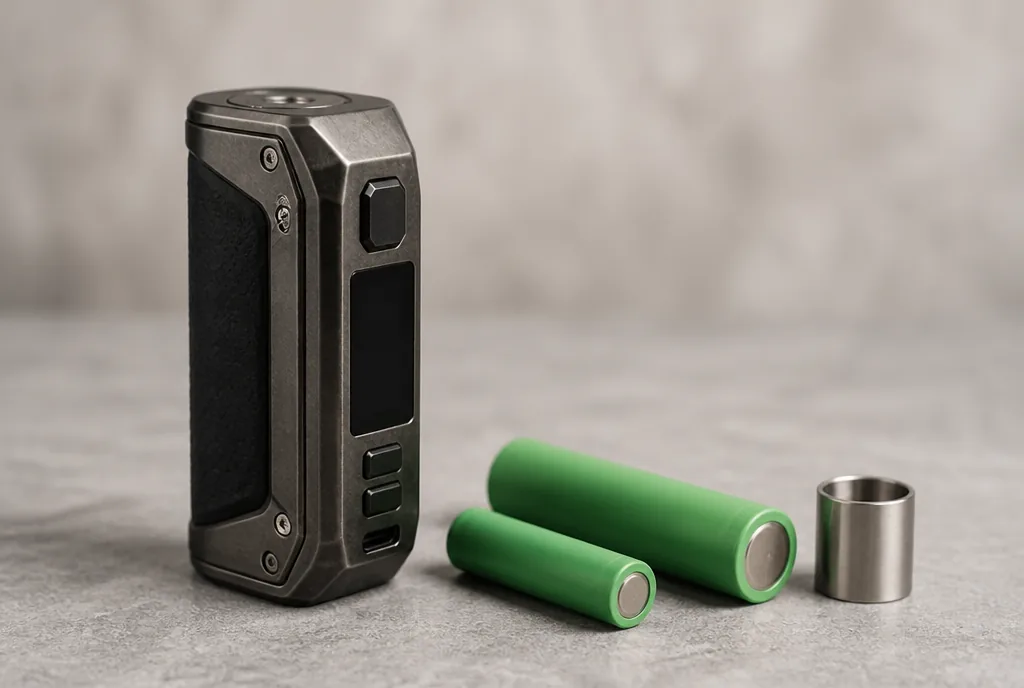
One hundred watts, one battery bay, and a chassis built to shrug off water, dust and knocks. The Geekvape Aegis Max 2 raises a question that product pages tend to skip. What does that much power demand from a single cell, and how long does the cell last behind it? The answer is not a matter of opinion. It comes from three published values, the power, the cell voltage and the cell capacity.
What 100 W asks of the Aegis Max 2 battery
At full output, the Aegis Max 2 pulls roughly 30 A from its single cell at the nominal 3.7 V, and close to 35 A as the cell nears the cut-off point. Both figures assume a conversion efficiency of 90 percent, which is a working assumption rather than a manufacturer figure.
The cell therefore needs a continuous discharge rating that covers that range. The format, a 21700 or an 18650 in the supplied adapter, changes the energy on board but not the current, which depends only on the power set and the cell voltage.
Aegis Max 2, Max100 or Max 100 kit, which device is which
The specification sheet published by Geekvape names the device “Max100 (Aegis Max 2)”, and UK retailers use either name, sometimes both. The Max 100 kit is the same mod bundled with the Z Subohm 2021 tank, two Z Series coils and an 18650 battery adapter.
It keeps the 5 to 100 W range and the single-cell layout of the first-generation Aegis Max. The brand comparison page, dated March 2022, lists what changed. The rating moved from IP67 to IP68, charging from micro-USB at 5 V and 1.5 A to USB-C at 5 V and 2 A, and the screen from a 0.96 inch monochrome panel to a 1.08 inch colour one.
100 W from one cell, working out the current draw
Current comes from one division, the power demanded over the cell voltage. The catch is that the voltage falls as the cell empties, and that no conversion is ever lossless.
Three voltages, three currents
The sheet gives an input voltage of 3.2 to 4.25 V, the span of a lithium-ion cell from full charge down to its low threshold, with the nominal 3.7 V sitting between the two. At 90 percent efficiency, the current drawn from the cell works out as follows.
| Power set | Full cell (4.2 V) | Nominal (3.7 V) | Low threshold (3.2 V) |
|---|---|---|---|
| 57 W | 15.1 A | 17.1 A | 19.8 A |
| 80 W | 21.2 A | 24.0 A | 27.8 A |
| 100 W | 26.5 A | 30.0 A | 34.7 A |
The 3.2 V floor, the demanding case
Near the end of a charge, at 100 W, the cell has to deliver close to 35 A for the mod to hold its setting. A cell rated at 30 A continuous covers the need when full, reaches its limit at 3.7 V, then goes past it as it drains.
That drift never appears on a product page, and it is the reason to leave a margin when choosing the cell.
Reading the cell datasheet
The rating that matters is the continuous discharge current published by the maker of the exact cell you own, not a pulse figure and not a number printed on a shop banner. Compare it with the low threshold column above rather than the nominal one.
Our guide to reading a 21700 battery shows where that line sits on a datasheet and why two cells of equal capacity can publish very different ratings.
Estimating Aegis Max 2 runtime on a 21700 or an 18650
No listing states a duration of use, since the cell is sold separately. A projection is still possible in two steps, energy on board and then the cost of a puff, provided each assumption is stated.
Stored energy by cell format
Take a 4000 mAh 21700 and a 3000 mAh 18650, both working assumptions. The first stores 4 Ah multiplied by 3.7 V, which gives 14.8 Wh, the second 11.1 Wh.
After the 90 percent efficiency, roughly 13.3 Wh and 10 Wh remain. The larger cell brings a third more energy, in line with our piece on why the 21700 mod took over.
Puff count by power setting
A two-second puff at 100 W uses 0.056 Wh, simply the power multiplied by the duration. The table sets that cost against the usable energy.
| Setting | Energy per 2 s puff | 21700 cell (13.3 Wh) | 18650 cell (10 Wh) |
|---|---|---|---|
| 45 W | 0.025 Wh | about 530 | about 400 |
| 57 W | 0.032 Wh | about 420 | about 315 |
| 80 W | 0.044 Wh | about 300 | about 225 |
| 100 W | 0.056 Wh | about 240 | about 180 |
A three-second puff takes a third off every value. Between 45 and 100 W the result is more than halved, whichever format you use.
What runtimes quoted in hours are worth
Some retailer reviews quote runtime in hours or days for different power profiles without stating how many puffs, or how long, the estimate rests on.
A duration depends on a rhythm that varies from one person to the next. A puff count depends only on the setting and the cell, which makes it the only sound basis for comparing two devices.
The Z coils in the kit, well short of 100 W
The kit ships with a pre-installed 0.2 ohm Z coil rated at 70 to 80 W and a spare 0.25 ohm coil rated at 45 to 57 W. Neither asks for 100 W.
At 80 W the first coil already pulls 24 A at nominal voltage and 27.8 A at the low threshold. A cell rated at 25 A covers that when full, but not near the end of a charge.
As with the Coolfire Z80 and its 80 watts, the maximum describes what the electronics can do. It only becomes relevant with an atomiser bought separately, the mod accepting coils from 0.1 to 3 ohms.
USB-C or an external charger, what 2 A delivers
The USB-C port takes 5 V at 2 A. A 4000 mAh cell therefore needs two hours in theory, 4000 divided by 2000, and a 3000 mAh 18650 an hour and a half.
The closing constant voltage phase adds a tail to that floor, so the figure is for comparing rather than timing. At 1.5 A, the first-generation Aegis Max needed around two hours forty minutes for the same 4000 mAh cell.
Charging inside the device is best kept as an occasional convenience, with a dedicated external unit preferred, a point our guide to choosing a vape battery charger develops in amps and cycles.
IP68 and spec sheets, what checks out and what does not
The IP68 rating follows the IEC 60529 standard. The 6 means fully dust-tight, the 8 means protection against prolonged immersion under conditions set by the manufacturer, who publishes neither a depth nor a duration here.
Several figures diverge between sources. The screen is listed at 1.1 inch in the manufacturer specifications and at 1.08 inch on its own comparison page, and at least one UK listing carries both values. No weight appears on the manufacturer page at all, while retailer figures disagree with one another.
The manufacturer gives 143.8 x 42.06 x 31.5 mm. Checking what each table measures before comparing two of them remains the rule.
What changes for a UK buyer
Refillable tanks sold in the United Kingdom are capped at 2 ml, and nicotine-containing e-liquid at 20 mg/ml in 10 ml bottles. The manufacturer lists a 2 ml TPD version of the Z Subohm 2021 tank alongside the 5.5 ml standard one, and a UK kit listing describes a 2 ml tank with a 2 ml spare glass.
Any 5.5 ml capacity quoted on an overseas listing therefore does not describe what reaches a UK address. The smaller tank changes nothing in the electrical arithmetic above.
FAQ
A few lines of the specification sheet get little attention from retailers. The answers below rely on the published figures and on the same arithmetic as above.
Does the Aegis Max 2 take a button-top cell?
No. The manufacturer states that the cell needs a flat surface at both ends for the battery door to close. A button-top cell does not suit this bay.
How long can the mod fire without a break?
Output cuts off after 10 seconds. At 100 W a press that long uses about 0.28 Wh, five times the cost of a two-second puff at the same setting.
What range does temperature control cover?
From 100 to 315 °C in 1 °C steps, or 200 to 600 °F in 5 °F steps. The mode needs a coil made from a compatible wire, nickel, titanium or stainless steel.
How much power is available on a 3 ohm coil?
Output tops out at 8.5 V. On 3 ohms Ohm’s law caps power at about 24 W, since 8.5 squared divided by 3 gives 24.1. The full 100 W is only reachable below roughly 0.72 ohm.
What is the A-Lock button for?
It locks the buttons to prevent accidental firing in a pocket or a bag. On a device able to pull 30 A from one cell, that lock is a safety feature more than a convenience.
Aegis Max 2, choosing the cell before the setting
The Aegis Max 2 illustrates a rule that reaches well beyond this model. A maximum power describes what the electronics can deliver, not what a single cell sustains without a margin.
Measured against the 3.2 V floor, its 100 W call for close to 35 A, while its supplied coils stay below 80 W. Before comparing the Aegis Max 2 with any other single-cell mod, those few calculations say more than the number printed on the box, and that reading of the data is what this site applies to every piece of vaping hardware.
On the same subject
- 21700 battery, reading capacity and runtime
- 21700 mod, why the format took over box mods
- Coolfire Z80, 80 watts from a single 18650
- Vape battery charger, reading amps and time
Editorial content for adult readers only. Vaping products can contain nicotine, a substance that causes addiction. Nicotine vaping products are not for sale to anyone under 18 in the UK. This article is not a buying recommendation.
Further reading
Explainers
Vape battery charger: reading amps and time
How to read a vape battery charger listing: working out charge time from the amp figure, how bays share current, and what a charge costs in cycles.
The market
21700 mod: why the format took over box mods
Why UK makers moved from 18650 to 21700, what the larger cell changes in runtime and bulk, and how single and dual battery mods split the market.
Trends
Oxva VPrime: what 2600 mAh actually covers
Oxva VPrime: 2600 mAh, 60 W, USB C charging. The calculation that links those figures to a runtime, and what the pod chosen changes in the result.