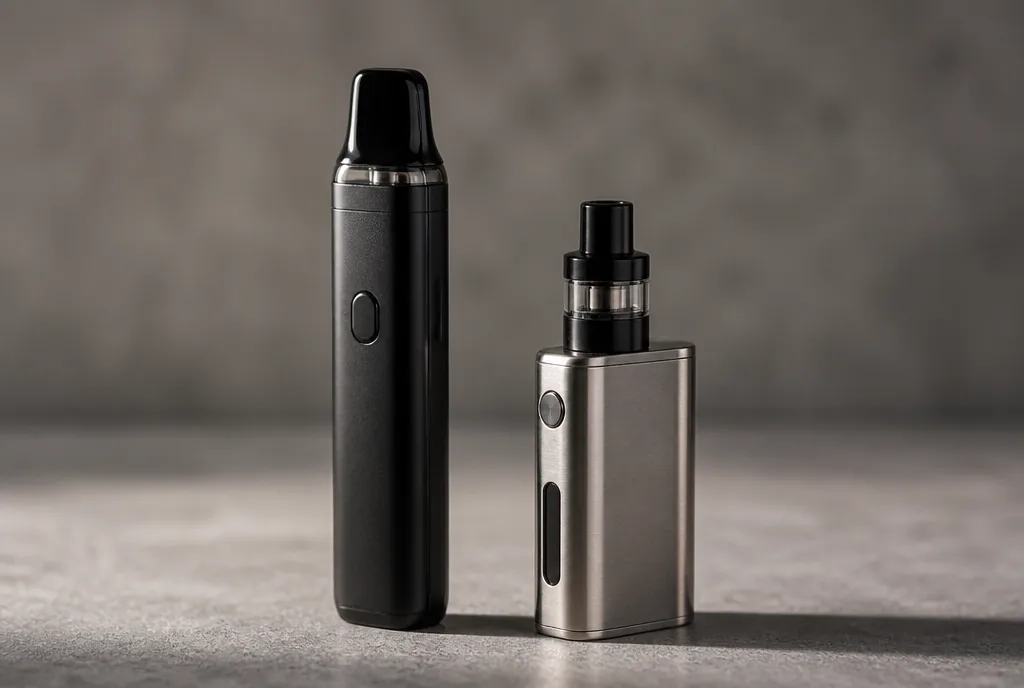
Oxva VPrime: what 2600 mAh actually covers
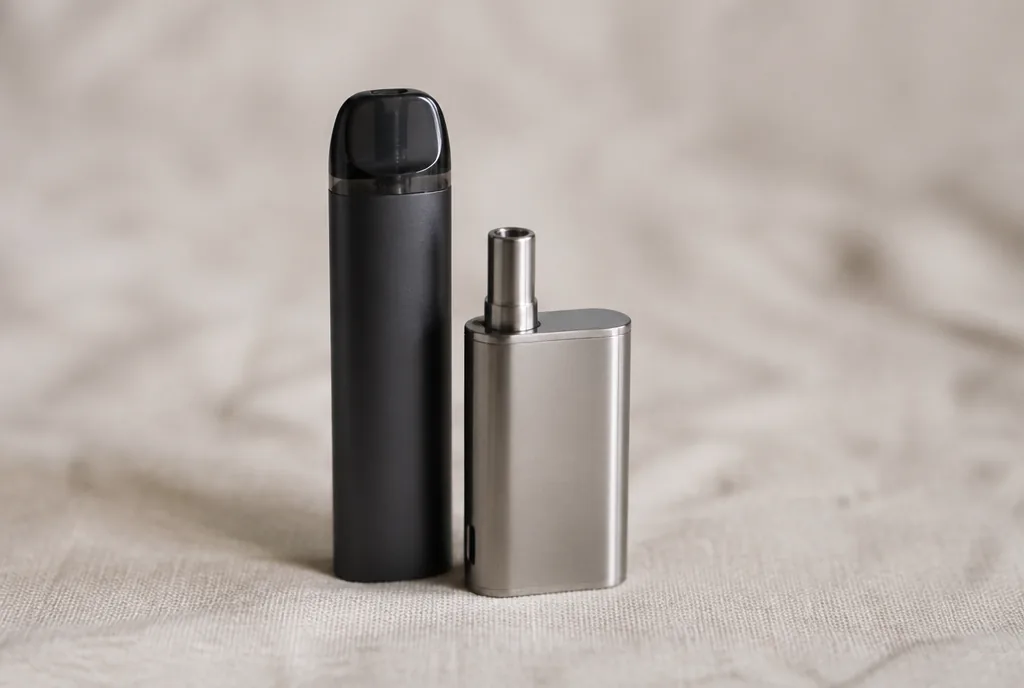
On a pod device with a sealed battery, the capacity is finally printed on the box. The figure of 2600 mAh appears on every British listing, alongside promises of use that run from a full day to a couple of days. Both claims can be true at once, but only if you know what separates them. The answer sits in the pod fitted, and it can be calculated.
What 2600 mAh represents on the Oxva VPrime
The Oxva VPrime carries a sealed 2600 mAh battery, a figure UK stockists including Ecigone, Vape UK and Vapestore all publish identically. Set against the nominal voltage of 3.7 V, that capacity corresponds to 9.62 Wh of stored energy.
It is the watt hour, not the milliamp hour, that compares directly with a vaping power. The conversion is a single multiplication, and it is what makes the rest of the reasoning possible at all.
Hold two assumptions in the open, a conversion efficiency near 90 percent and a discharge carried down to the point where the board cuts off, and the energy genuinely available comes out around 8.7 Wh. That is the working figure for everything below.
Turning that energy into a puff count
No listing publishes a puff count, and with good reason: it depends on the setting. What follows is an arithmetic projection rather than a recorded observation, and its value lies in comparing two configurations.
The device is sold in Britain with UniTech 2.0 pods running from roughly 0.2 to 0.8 ohm, and the maximum output is 60 W. The lower resistance pods sit at the top of that band, the higher resistance ones considerably below it, and the two bands barely overlap.
A puff draws a given power for a given time. At 55 W over two seconds it uses about 0.031 Wh. At 25 W over the same two seconds it uses about 0.014 Wh, a little more than twice as little.
Start from 8.7 Wh available. The high output configuration places the total near 280 two second puffs. The lower output configuration lifts it towards 620. That factor of roughly 2.2 explains on its own the whole spread of the marketing claims: the day of use and the two days describe the two ends of the same power range.
Two things sit outside the calculation. The 0.96 inch colour screen and the chipset both draw power between puffs, and voltage sags under load, which reduces the energy extractable towards the end of a discharge.
The charging figures and whether they hold up
The USB C port supports fast charging, and British listings describe a recharge in a little over an hour. That claim is unusual in that it can be checked, which is worth noting in a category where most figures cannot.
The check is a division: 2600 mAh divided by a 2000 mA charge current gives about one hour and eighteen minutes in theory, before the closing constant voltage phase adds its tail. The order of magnitude quoted by retailers therefore holds up arithmetically.
Set against the capacity, that current represents roughly 0.77 times the hourly capacity of the battery. That is a brisk regime, considerably higher than the lowest setting on an external unit, as our guide to choosing a vape battery charger sets out.
What a sealed battery changes in how you read the numbers
A sealed battery device inverts the logic of removable cell hardware. Capacity is known in advance, which is a real advantage, but it is fixed: there is no swapping in a more generous cell when the original fades.
In exchange the estimate becomes far more reliable. On a device running removable cells the stored energy depends entirely on what was bought separately, as the case of the Lost Vape Centaurus BT200 makes plain, and no honest runtime figure can be printed on the box.
The adjustment variable therefore shifts entirely to the setting. On the Oxva VPrime, choosing a pod is choosing a runtime, in a ratio the arithmetic places at around two. Nothing about the hardware changes between the two cases.
There is a second consequence worth naming. A sealed battery has a finite cycle life like any other, and when it fades the whole device fades with it, where a removable cell device is repaired by buying a cell. That trade off is the real dividing line between the two families, rather than any figure on the specification sheet.
British specifics that change the product
Two United Kingdom rules change what actually arrives at a British address, and both are easy to miss when comparing listings across borders.
Refillable pods and tanks sold in the United Kingdom are capped at 2 ml. Any larger pod capacity quoted for this device on an overseas page does not describe the version sold here, and the difference is not a retailer error but a legal one.
Nicotine containing e liquid is capped at 20 mg/ml and sold in 10 ml bottles, and the whole category is restricted to adults aged 18 and over. Together those rules explain why refill frequency features so heavily in British discussion of pod devices and barely at all elsewhere.
A third specific is worth adding. Because the pods are the consumable here, the running arithmetic that matters over a year is the pod replacement rhythm rather than the battery, and UK reviewers place typical pod life at a few weeks depending on the liquid used.
How this device compares with a removable cell setup
Stored energy is where the two families separate most clearly. At 9.62 Wh nominal this device carries less than a single large removable cell, which is the direct consequence of a slim chassis with no battery door.
That comparison is only meaningful in watt hours. Comparing a 2600 mAh sealed battery against a 5000 mAh removable cell on milliamp hours alone would be reasonable here, since both sit at the same nominal voltage, but the moment a series arrangement enters the picture that shortcut breaks down entirely.
The reference points for the removable side, including how to read a discharge line off a datasheet rather than a shop page, sit in our guide to reading a 21700 battery. The method transfers in both directions, and it is the only way to hold two very different devices up against each other honestly.
Frequently asked questions
Does automatic resistance detection change consumption?
It proposes a power suited to the pod fitted. The setting remains adjustable, and it is that setting, not the detection, that determines the energy each puff uses.
How long does a pod last before replacement?
British reviewers place typical life at a couple of weeks or so depending on use and on the liquid involved. That duration is independent of the battery runtime.
Does the mid range pod resistance change the calculation?
It exists in the range, but where no recommended wattage band is published for it, no serious projection is possible. The absence of a figure is itself the answer.
Does pod capacity correspond to battery runtime?
Nothing links the two mechanically. Liquid consumption depends on power and draw style, electrical consumption does too, but their rhythms do not necessarily coincide.
Why does the charge level not fall in a straight line?
A lithium battery does not hold its voltage steadily. The drop steepens towards the end of a discharge, which is why the last displayed percentages disappear faster than the first ones.
Reading the Oxva VPrime: a capacity, a power, a ratio
The Oxva VPrime is a useful teaching case because its three key figures are published and consistent with one another: 2600 mAh of capacity, a range up to 60 W, and a charging claim that survives being checked against the arithmetic.
Once the capacity is converted into watt hours and set against the setting actually used, runtime stops being a marketing argument and becomes a division. That single operation is what lets you compare two devices of completely different formats without taking anybody’s word for anything.
Editorial content for adult readers only. Vaping products generally contain nicotine, a substance that causes addiction. Not for sale to anyone under 18 in the United Kingdom. This article is not a buying recommendation.
Further reading
The market
21700 mod: why the format took over box mods
Why UK makers moved from 18650 to 21700, what the larger cell changes in runtime and bulk, and how single and dual battery mods split the market.
Data
Coolfire Z80: 80 watts from a single 18650
Coolfire Z80: 80 W advertised, one 18650 cell, USB C charging. What arithmetic says about the power actually sustainable and about runtime.
The market
Centaurus BT200: runtime on two 18650 cells
Centaurus BT200: 200 W, two 18650 cells, 5V/2A charging. What those figures become once converted into energy and a calculated runtime.